
As this year is coming to an end, I would like to thank everybody who has written to us and asked asked questions on learning both Haitian Creole and French. It is time to take stock of what we have accomplished together on this exciting journey. I want to inform you that there are greater things to come in the next few years on this blog and http://haitiancreolemp3.libsyn.com.
As the blogger of this site (http://sakpaselearnhaitiancreole.blogspot.com) and the founder of free haitiancreolemp3 podcast, I want to thank you for letting me know what you want to learn. I have been pleased to answer your language and culture lessons and encourage you to learn by providing you with free downloads of creole lessons and vocabulary.
Wherever you are in the United States and the rest of the world, you can learn Haitian Creole online via Skype.com. If you have access to a computer or you have a Google account, you can learn the haitian language.
Find out how you can do that by visiting http://worldwidehaitiancreoleclasses.blogspot.com
Whether you live in Miami, Florida, Franklin, Tennessee, Allen Texas, Santa Barbara, California, San Diego, California, Japan, Belgium, France, England, Argentina, Brasil, Peru or anywhere in the world, you can use Skype to learn Kreyol, Haitian Creole.
Whether your primary language is English or Spanish, I have made some free lessons available to you at http://aprenderkreyolhaitiano.blogspot.com. I have also provided with various additional resources which you can find on the following blogs and sites:
http://creolechildrensbooks.blogspot.com
http://newyorkcreolebooks.blogspot.com
http://frenchlessonpodcast.libsyn.com
http://learnfrenchonlinefree.libsyn.com
http://urbanebookspublishingb.blogspot.com
http://newwavepublishing.blogspot.com
Bòn Ane! – Happy New Year! (note that “nouvèl – new” is not said/used here)
Jwaye Nowèl! – Merry Christmas!
Women entrepreneurs - Timachann, madan sara, (They are often peddlers or street vendors)
Friday, December 23, 2011


Friday, November 18, 2011
Yummy Haitian Meals, Turkey Meat or Vyann Kodin, Breadfruit or Veritab!
Thanksgiving in Haitian Creole: Creolizing the Turkey (Kodin), Breadfruit (veritab) Story, and Haitian Meat Recipes
Purchase a PDF copy of "Thanksgiving in Haitian Creole: Creolizing the Turkey (Kodin), Breadfruit (veritab) Story, and Haitian Meat Recipes"
Vocabulary:
Bouyon Bèf - Beef Stew - Boeuf à l’Haitienne
Se vyann bèf ak tomat e piman bouk. Li gou anpil. (It is a flavorful, tasty beef with tomatoes and peppers.)
Diri kole / Diri ak Pwa - Riz et Pois - Haitian red beans and rice
Diri Olè - Haitian Rice Pudding - Arroz con Leche
Griyo (Grillots) - Yummy, Tasty, flavorful cubes of glazed, fried pork
These cubes are often soaked for an hour or so in sour orange marinade, then slow-roasted until they become tender. Then fry them in oil until they look caramelized. Yummy!
Mayi Moulin (Mais moulu) - Haitian Cornmeal Mush
Thanksgiving Vocabulary:
Cornbread or American cornmeal bread - Pen mayi Moulin
Cranberry - Kannbèj
Squash / pumpkin - joumou (gato joumou - pumpkin pie)
Patat dous - sweet potatoes called yams in the US.
Yams can be white and yellow in the Caribbean and Africa. Yanm is the creole word.
Kodin woti - roasted turkey, dinde rôtie
================
On the Menu - Sur La Table - Sa N’ap Sèvi
Non Resèt Ayisyen - Names of Haitian Recipes - Les Noms des Recettes Haitiennes - Los Nombres de las Recetas Haitianas
Bannann Peze - Haitian twice-fried green plantains
Bananes Pesées (French)
Tostones is bannann peze is a snack or side dish in Puerto Rico, Cuba, and the Dominican Republic.
Patacones is bannann peze in Central America, Peru, Ecuador and Venezuela
Notes: You will need a tostonera to flatten the plantains before their second frying. Or any flat surface, a glass or a small plate will do too.


Thanksgiving in Haitian Creole: Creolizing the Turkey (Kodin), TonmTonm, the Breadfruit (veritab) Story, and Haitian Meat Recipes
Purchase a PDF copy of "Thanksgiving in Haitian Creole: Creolizing the Turkey (Kodin), Breadfruit (veritab) Story, and Haitian Meat Recipes"
Purchase a PDF copy of "Thanksgiving in Haitian Creole: Creolizing the Turkey (Kodin), Breadfruit (veritab) Story, and Haitian Meat Recipes"

Bannann Peze - Haitian twice-fried green plantains
Bananes Pesées (French)
Tostones is bannann peze is a snack or side dish in Puerto Rico, Cuba, and the Dominican Republic.
Patacones is bannann peze in Central America, Peru, Ecuador and Venezuela
Notes: You will need a tostonera to flatten the plantains before their second frying. Or any flat surface, a glass or a small plate will do too.
Purchase a PDF copy of "Thanksgiving in Haitian Creole: Creolizing the Turkey (Kodin), Breadfruit (veritab) Story, and Haitian Meat Recipes"
Vocabulary:
Bouyon Bèf - Beef Stew - Boeuf à l’Haitienne
Se vyann bèf ak tomat e piman bouk. Li gou anpil. (It is a flavorful, tasty beef with tomatoes and peppers.)
Diri kole / Diri ak Pwa - Riz et Pois - Haitian red beans and rice
Diri Olè - Haitian Rice Pudding - Arroz con Leche
Griyo (Grillots) - Yummy, Tasty, flavorful cubes of glazed, fried pork
These cubes are often soaked for an hour or so in sour orange marinade, then slow-roasted until they become tender. Then fry them in oil until they look caramelized. Yummy!
Mayi Moulin (Mais moulu) - Haitian Cornmeal Mush
Thanksgiving Vocabulary:
Cornbread or American cornmeal bread - Pen mayi Moulin
Cranberry - Kannbèj
Squash / pumpkin - joumou (gato joumou - pumpkin pie)
Patat dous - sweet potatoes called yams in the US.
Yams can be white and yellow in the Caribbean and Africa. Yanm is the creole word.
Kodin woti - roasted turkey, dinde rôtie
================
On the Menu - Sur La Table - Sa N’ap Sèvi
Non Resèt Ayisyen - Names of Haitian Recipes - Les Noms des Recettes Haitiennes - Los Nombres de las Recetas Haitianas
Bannann Peze - Haitian twice-fried green plantains
Bananes Pesées (French)
Tostones is bannann peze is a snack or side dish in Puerto Rico, Cuba, and the Dominican Republic.
Patacones is bannann peze in Central America, Peru, Ecuador and Venezuela
Notes: You will need a tostonera to flatten the plantains before their second frying. Or any flat surface, a glass or a small plate will do too.


Thanksgiving in Haitian Creole: Creolizing the Turkey (Kodin), TonmTonm, the Breadfruit (veritab) Story, and Haitian Meat Recipes
Purchase a PDF copy of "Thanksgiving in Haitian Creole: Creolizing the Turkey (Kodin), Breadfruit (veritab) Story, and Haitian Meat Recipes"
Purchase a PDF copy of "Thanksgiving in Haitian Creole: Creolizing the Turkey (Kodin), Breadfruit (veritab) Story, and Haitian Meat Recipes"
Or download a copy of "Thanksgiving in Haitian Creole...and TonmTonm, The Breadfruit Story..." from Smsahwords.com now
Vocabulary:
Or download a copy of "Thanksgiving in Haitian Creole...and TonmTonm, The Breadfruit Story..." from Smsahwords.com now
Vocabulary:
Bouyon Bèf - Beef Stew - Boeuf à l’Haitienne
Se vyann bèf ak tomat e piman bouk. Li gou anpil. (It is a flavorful, tasty beef with tomatoes and peppers.)
Diri kole / Diri ak Pwa - Riz et Pois - Haitian red beans and rice
Diri Olè - Haitian Rice Pudding - Arroz con Leche
Griyo (Grillots) - Yummy, Tasty, flavorful cubes of glazed, fried pork
These cubes are often soaked for an hour or so in sour orange marinade, then slow-roasted until they become tender. Then fry them in oil until they look caramelized. Yummy!
Mayi Moulin (Mais moulu) - Haitian Cornmeal Mush
Thanksgiving Vocabulary:
Cornbread or American cornmeal bread - Pen mayi Moulin
Cranberry - Kannbèj
Squash / pumpkin - joumou (gato joumou - pumpkin pie)
Patat dous - sweet potatoes called yams in the US.
Yams can be white and yellow in the Caribbean and Africa. Yanm is the creole word.
Kodin woti - roasted turkey, dinde rôtie
================
On the Menu - Sur La Table - Sa N’ap Sèvi
Non Resèt Ayisyen - Names of Haitian Recipes - Les Noms des Recettes Haitiennes - Los Nombres de las Recetas Haitianas
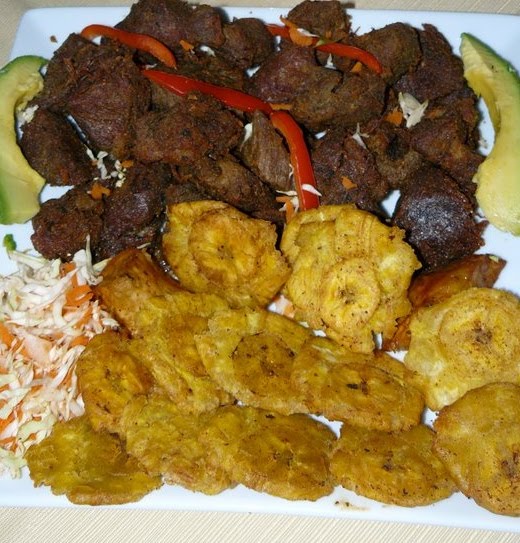
Bannann Peze - Haitian twice-fried green plantains
Bananes Pesées (French)
Tostones is bannann peze is a snack or side dish in Puerto Rico, Cuba, and the Dominican Republic.
Patacones is bannann peze in Central America, Peru, Ecuador and Venezuela
Notes: You will need a tostonera to flatten the plantains before their second frying. Or any flat surface, a glass or a small plate will do too.
Find other resources and books right here:
Haitian Foods and Fruits Names... from Barnes and Noble as a Nook ebook.
Purchase a copy of "Haitian Foods and Fruits Names...from Amazon Kindle as a kindle ebook.
============
Thanksgiving in Haitian Creole: Creolizing the Turkey (Kodin), Breadfruit (veritab) Story, and Haitian Meat Recipes
Purchase a PDF copy of "Thanksgiving in Haitian Creole: Creolizing the Turkey (Kodin), Breadfruit (veritab) Story, and Haitian Meat Recipes"
Or download a copy of "Thanksgiving in Haitian Creole...and TonmTonm, The Breadfruit Story..." from Smsahwords.com now
Vocabulary:
Bouyon Bèf - Beef Stew - Boeuf à l’Haitienne
Se vyann bèf ak tomat e piman bouk. Li gou anpil. (It is a flavorful, tasty beef with tomatoes and peppers.)
Diri kole / Diri ak Pwa - Riz et Pois - Haitian red beans and rice
Diri Olè - Haitian Rice Pudding - Arroz con Leche
Griyo (Grillots) - Yummy, Tasty, flavorful cubes of glazed, fried pork
These cubes are often soaked for an hour or so in sour orange marinade, then slow-roasted until they become tender. Then fry them in oil until they look caramelized. Yummy!
Mayi Moulin (Mais moulu) - Haitian Cornmeal Mush
Thanksgiving Vocabulary:
Cornbread or American cornmeal bread - Pen mayi Moulin
Cranberry - Kannbèj
Squash / pumpkin - joumou (gato joumou - pumpkin pie)
Patat dous - sweet potatoes called yams in the US.
Yams can be white and yellow in the Caribbean and Africa. Yanm is the creole word.
Kodin woti - roasted turkey, dinde rôtie
================
On the Menu - Sur La Table - Sa N’ap Sèvi
Non Resèt Ayisyen - Names of Haitian Recipes - Les Noms des Recettes Haitiennes - Los Nombres de las Recetas Haitianas
Bannann Peze - Haitian twice-fried green plantains
Bananes Pesées (French)
Tostones is bannann peze is a snack or side dish in Puerto Rico, Cuba, and the Dominican Republic.
Patacones is bannann peze in Central America, Peru, Ecuador and Venezuela
Notes: You will need a tostonera to flatten the plantains before their second frying. Or any flat surface, a glass or a small plate will do too.
Find other resources and books right here:
Haitian Foods and Fruits Names... from Barnes and Noble as a Nook ebook.
Purchase a copy of "Haitian Foods and Fruits Names...from Amazon Kindle as a kindle ebook.
Tuesday, November 15, 2011
Very Tasty Haitian Meals: Thanksgiving in Haitian Creole, Turkey Meat or Vyann Kodin, Breadfruit or Veritab
Thanksgiving in Haitian Creole: Creolizing the Turkey (Kodin), Breadfruit (veritab) Story, and Haitian Meat Recipes
Purchase a PDF copy of "Thanksgiving in Haitian Creole: Creolizing the Turkey (Kodin), Breadfruit (veritab) Story, and Haitian Meat Recipes"
Vocabulary:
Bouyon Bèf - Beef Stew - Boeuf à l’Haitienne
Se vyann bèf ak tomat e piman bouk. Li gou anpil. (It is a flavorful, tasty beef with tomatoes and peppers.)
Diri kole / Diri ak Pwa - Riz et Pois - Haitian red beans and rice
Diri Olè - Haitian Rice Pudding - Arroz con Leche
Griyo (Grillots) - Yummy, Tasty, flavorful cubes of glazed, fried pork
These cubes are often soaked for an hour or so in sour orange marinade, then slow-roasted until they become tender. Then fry them in oil until they look caramelized. Yummy!
Mayi Moulin (Mais moulu) - Haitian Cornmeal Mush
Thanksgiving Vocabulary:
Cornbread or American cornmeal bread - Pen mayi Moulin
Cranberry - Kannbèj
Squash / pumpkin - joumou (gato joumou - pumpkin pie)
Patat dous - sweet potatoes called yams in the US.
Yams can be white and yellow in the Caribbean and Africa. Yanm is the creole word.
Kodin woti - roasted turkey, dinde rôtie
================
On the Menu - Sur La Table - Sa N’ap Sèvi
Non Resèt Ayisyen - Names of Haitian Recipes - Les Noms des Recettes Haitiennes - Los Nombres de las Recetas Haitianas
Bannann Peze - Haitian twice-fried green plantains
Bananes Pesées (French)
Tostones is bannann peze is a snack or side dish in Puerto Rico, Cuba, and the Dominican Republic.
Patacones is bannann peze in Central America, Peru, Ecuador and Venezuela
Notes: You will need a tostonera to flatten the plantains before their second frying. Or any flat surface, a glass or a small plate will do too.
Saturday, September 17, 2011
Hablemos el Creole Haitiano / Let us Speak Haitian Creole / Ann Pale Kreyol
Hablemos el Criollo Haitiano - Let Us Speak Haitian Creole - Ann Pale Kreyol : El Creole Haitiano Para Hispanohablantes - El Creole Haitiano para Maestros, Estudiantes, y los Hablantes De Inglès y Espaňol - Haitian Creole for ESOL Teachers, Pupils

Written in English, Spanish, Haitian Creole and some French, "Hablemos el Criollo Haitiano: El Creole Haitiano Para Hispanohablantes - El Creole Haitiano para Maestros, Estudiantes, y los Hablantes De Inglès y Espaňol - Haitian Creole for Teachers, Students, and English and Spanish Speakers - Hablemos el Creol: Guía de Creol en Espaňol" is designed to help English, French, and Spanish speakers learn and Speak Haitian Creole in no time. This book is a guide that will provide you with the key vocabulary in almost four languages (Spanish, English, French, and Haitian Creole). It was designed to give both speaking and reading practice, each of the lesson units furthers comprehension through short dialogs, pronunciation guides, grammar notes, and a variety of drills and exercises.
Discover the meaning of words and expressions such as "sa-k pase?" "Griyo - grilled pork," "Taso," "Mayi Moulen ak fèy - corn mush with greens," "fritay - fritters, fried stuff, fried malanga," "Madan sara," "Labapen," "Kowosòl - soursop," “fwidemè - seafood” and many more. Find out the names of haitian meals and fruits...
The examples are English-Creole-Spanish and Creole-English-Spanish It was developed by Joseph J. Charles of Haitian Creole MP3 Institute (http://haitiancreolemp3.libsyn.com)
Saturday, September 10, 2011
Church Songs and Children's Choruses in Haitian Creole and French: Find the Most Popular list of Songs

Use this product ID: 4291 to purchase a copy below. Get the accompanying lyrics and ebook from Amazon Kindle right here.
Product ID: 4291
Product Name: Selected Popular Haitian Church Hymns and Children's Choruses, 2nd Edition. 9/2011
Buy Now From CCNow
or
Product ID: 3064
Product Name: Haitian Chants of Hope
Buy Now From CCNow
or
Product ID: 3068
Product Name: Most Popular Haitian Children's Church Choruses: A 10-song CD + Bonus:
Buy Now From CCNow
or
Product ID: 3122
Product Name: 3122: Learn Haitian Creole in one Week CD
Buy Now From CCNow
or
Product ID: 3133
Product Name: Ann Pale Yon Ti Kreyol CD - Ann Pale Kreyol Audio
Buy Now From CCNow
or
Saturday, August 20, 2011
Sispann Ponpe Sou Kabann nan - Stop Jumping on the Bed - No Salten en la Cama

Bilingual Story Delivered in PDF: This children's story is written in English and Haitian Creole. Use Paypal to Purchase a copy now:
Review of the ebook
Pa Ponpe Sou Kabann nan! – Stop Jumping on the Bed! - No Salten en la Cama! is the story of six siblings: Lili, Lala, Lolo, Lila, Lola and Lele who could never stop jumping on their parents' bed until a series of mishaps and accidents started taking place. Manman Baba and Papa Bibi's kids were only afraid of the housemaid who often complained about having to clean up all these children's mess. One day, Manman Baba stayed home and found out how much headache her children can give to the sitter and maid. Find out what happened to the kids and why they finally decided to change and stop messing around so much.
If you want to purchase a copy, do so here
Vocabulary:
I miss you - M sonje ou / m sonje w
Sunday, August 14, 2011
HaitianCreoleMP3 Gives You Access to Free MP3 Downloads, Learn Haitian Creole Now
Find a brief review of all the 2011 monthly MP3 downloads (Hallan un repasito de todas las lecciones de 2011)
Read this introduction to Haitian Creole and Creole languages: Introduction to Haitian Creole and Overview of Nouns, Verbs, Sentence Structures, Pronouns etc.
Haitian Creole Lessons for all of January 2011 / Lecciones de Creol en el mes de Enero de 2011
Haitian Creole Lessons for all of February 2011 / Lecciones de Creol en el mes de Febrero de 2011
Haitian Creole Lessons for all of March 2011 / Lecciones de Creol en el mes de Marzo de 2011
Haitian Creole Course for all of April 2011 / Lecciones de Creol en el mes de Abril de 2011
Haitian Creole Course for all of May 2011 / Lecciones de Creol en el mes de Mayo de 2011
Haitian Creole Lessons for all of June 2011 / Lecciones de Creol en el mes de Junio de 2011
Haitian Creole Lessons for all of July 2011 / Lecciones de Creol en el mes de Julio de 2011
2010
Friday, August 5, 2011
Learn Haitian Creole for Free: Download and Listen to Free MP3 (audio) Files
This is just a sample of the excerpt from the textbook, "Quick Haitian Creole Grammar Reference: Ann Pale Kreyol Chak Jou - Let's Learn Haitian Creole Every Day" which can be found right on Amazon Kindleand Barnes and Noble Nook Book.
The excerpt is from pages 180-186
Find the rest of this episode on http://newwaveselfpublishing.blogspot.com, http://newwavepublishing.blogspot.com,http://kreyolpalekreyolkonprann.blogspot.com, and http://childrenscreolebooks.blogspot.com
Addendum #2: Dyalòg ak Vokabulè
Dyalòg ak Vokabulè
Toma ak Titonton rankontre – Toma and Titonton met
Toma: Bonjou, Titonton. Ki jan ou ye jodi-a? (Hello, Titonton. How are you today ?)
Titonton: M’ byen. E ou menm? Ban-m nouvèl papa ou ? (I’m fine. And you ? How is your father?)
Toma : M byen wi. Papa-m pa gaya (I am fine. My father is not well. He is ill)
Titonton: Ki jan Marimat ye? Eske l’ap demele-l? (How is Marimat? Is she getting along?)
Toma: Marimat byen wi. L’ap kenbe (Marimat is fine. She is getting along)
Titonton: Sa fè lontan nou pa wè. S’ak pase ? (We have not seen each other for a long time. What’s up?
Toma: Monchè, m’ap boule (my dear, I am managing)
Titonton: Bon, monchè, ban-m nouvèl mennaj ou a ? (Okay, dear, how about your girlfriend ? )
Toma : Nou te kraze sa (We had a breakup or we broke up)
Titonton: Depi kilè ou pa ansanm avèk li ? (How long have you not been with her ?)
Toma: Ou enterese nan li? (Are you interested in her?)
Titonton: M pa menm konn non-l, non. Ki jan’ l rele ankò? (I do not even know her name. What’s her name?)
Toma: Li rele Jaklin. (Her name is Jaklin)
Titonton: An Kreyòl, se Jaklin. An fransè, se Jacqueline. (In Creole, it’s Jaklin. In French, it’s Jacqueline)
Toma : Monchè, kite-m kraze rak / Kite-m ale ! (my dear friend, let me take leave of you. Let me go!”
Titonton: Oke Toma. N’a wè mwa pwochen si Bon Dye vle. (See you next month, God willing !)
Toma: Oke. N’a wè nan inivèsite-a (Right. See you at the university).
Additional Haitian Creole Expressions and Explanations:
M’ap kenbe – I’m getting along
M’ap boule – I am managing
Mwen la / m la – I’m okay
M pa pi mal - I am no worse
M byen – I am fine
Wi – yes
Non – no
Explanations of Wi and Non in a sentence:
Use “Wi – yes” with positive declaration sentences. Non is used with negative declarative sentences.
Exercises – Egzèsis:
Ki sa? What ? Sa ? what?
Ki sa sa-a ye? What is this ?
Sa ou pral fè lavil? (What are you going to do downtown ?)
Sa ou ap chache la-a? (What are you looking for here ?)
Sa ou bezwen? Sa w bezwen? Ki sa ou bezwen? (What do you need ?)
Ki sa ou fè lè ou malad ? What do you do when you get sick ?
M-al nan dispansè-a / I go to the healthy station.
Repete – Repeat
Ki sa sa-a ye?
Se yon zeguy – It is a needle
Ki sa sa-a ye?
Se yon mato – It is a hammer
Eske gen yon tibokit sou sab la? Is there a pale on the sand ?
Ki kote? Kote? Ki bò? Where?
Ki kote ou travay? Where?
Ki kote ou ap travay? Ki bò ou ap travay ? Where are you working ?
M’ap travay nan izin nan – I am working in the factory
Ki kote ou prale? – Where are you going?
M pral legliz (church)
M pral nan mache (market)
M pral Pòtoprens (Port-au-Prince
M pral anba lavil (downtown)
M pral lapòs (Post office)
M pral lekòl (school)
M pral danse nan rara (popular music and dance)
M pral nan kanaval (carnival)
M pral Fòlibète – I am going to Fort Liberté
M pral Kap Ayisyen. Kap Ayisyen nan nò peyi dayiti
Ki kote lèkay ye? Lèkay nan sid peyi a
Ki kote Jakmèl ye?
Ki kote Gonayiv ye?
Ki bò Jeremi ye?
Ki sa ou pral fè lavil ?
M pral voye yon lèt ak yon kasèt bay manman-m k’ap viv Nouyòk ( I am going to send a letter and a casette tape to my mother who is living in New York)
M pran nan mache Fè pou-m sa achte materyèl lekòl pou timoun yo (I am going to the Iron Market to buy school supplies for the kids)
Nòt Kreyol: Translation of the Preposition “To” indicating motion to a place:
Kreyòl uses “Nan” before the noun indicating the place to express motion to a place. Also, keep in mind that nouns that refer to specified, unique places usually do not need the definite article. For example, I am going to church – M pral legliz; I am going to school – M pral lekòl.
Ki kote konpè Jak prale? Where brother Jak going ?
Li pral travay nan jaden li - He is going to work in his garden.
Poukisa – Why?
Poukisa tout timoun sa yo ap mache yonn dèyè lòt konsa? Y-ap mache an fil endyen – Why are all these kids walking in line like this ?
Se yon pwosesyon. Gen yon mès nan legliz katolik la – It is a procession. There is a mass at the catholic church.
Pè-a pral bay lamès – The priest is going to preside over the mass
Ki moun ki / Ki moun - Who
Ki moun ki pral Kanada? Who is going to Canada?
Ki moun ou vle envite nan fèt ou a ? Whom do you want to invite to your party ?
Ki moun ki vle ede-m? Who wants to help me?
Ki moun ki konn danse ? Who knows how to dance ?
Eske ou konnen yon moun ki konn pale alman? (Do you know somebody who knows German ?)
Ki moun ki pale fransè nan legliz la ? Who speaks French in church ?
Pa gen moun ki pale fransè ak alman nan legliz la – There is nobody who speaks French and German in the church
Possessive in Creole
Whose is it? Se pou ki moun?
(Belonging to, pertaining to, indicating possession)
Bato sa-a se pou Jan. Se bato Jan.
Se rad Tipapa. Rad sa-a se pou Tipapa
Notes / Nòt: An easy way to understand and express possession in Haitian Creole is to have the noun referring to what is owned followed by the name of the owner. If a pronoun follows a noun, it is used as a possessive adjective.
Examples: Se lajan/kòb Delòm. Se kòb li – (It’s Delòm’s money. It is his money)
Se chokola Manno ak Wobè. Se chokola yo – It is Manno and Robert’s chocolate. It is their chocolate.
Se vwazin Terèz – Se vwazin li – She is Teresa’s neighbor. She is her neighbor
Se liv Joslen. Se liv li – It is Jocelyn’s book. It is his.
Se mallet Jisten. Se malèt li – It is Justin’s suitcase. It is his suitcase.
Konbyen? – How much / How many?
Konbyen rad ou wè nan chanm nan? - How many pieces of cloth do you see in the room ?
M wè yon chemiz (shirt), yon pè pantalon (pants), yon mayo (t-shirt), yon pè soulye (a pair of shoes), de pè sapat (a pair of thongs), yon kravat (tie), de jip (skirt) yon pè chosèt (socks), yon pè tenis (a pair of tennis shoes) epi yon ba (stockings)
Other forms of possession: Asking questions
Pou ki moun kay sa yo ye? Poukiyès kay sa yo ye? Whose are those houses?
Pou ki moun plim sa-a ye? Poukiyès plim sa-a ye? Whose is this pen?
Pou ki moun kreyon sa-a ye? Poukiyès kreyon sa-a ye? Whose is this pencil?
Sa yo se kay leta (kay gouvènman) – These are government houses /buidings
Pouki moun plaj sa yo ye? Poukiyès plaj sa yo ye? Se plaj prive
Whose are these beaches? They are private beaches
********************************
Eske ou gen yon bagay? Do you have anything (something)?
Non. M pa gen anyen – No, I do not have anything
Monday, August 1, 2011
Saturday, July 23, 2011
Ann Pale Kreyol Ak "Sa-k Pase? Learn Haitian Creole Textbook"

Joseph J. Charles, M.S.
List Price: $29.99
5.25" x 8" (13.335 x 20.32 cm)
Black & White on Cream paper
140 pages
ISBN-13: 978-1451536119
ISBN-10: 1451536119
BISAC: Foreign Language Study / Creole Languages
Book Review:
SakPaseLearnHaitianCreole is designed to help beginning and intermediate learners of Haitian Creole get the support they need with the grammar, vocabulary, exercises and phonology of the language. The lessons cover various topics such as daily Haitian life, disaster relief language, family interactions, community life, shopping, medical care and polite or appropriate communication, schools and church activities.
Purchase a copy of this textbook to learn Haitian Creole now: SakPaseLearnHaitianCreole Textbook
Tuesday, June 14, 2011

Saturday, May 28, 2011
Free Creole Download - Free Audio of Podcast episode: "Short Conversations and Dialogues: Vwala Se Te Yon Fwa (Once Upon a Time)
You can find this booklet at the following sites. (Pueden encontrar este libro en) http://aprenderkreyolhaitiano.blogspot.com, http://urbanebookspublishing.blogspot.com, http://urbanbookspublishing.blogspot.com
Madan Cherilis Granpanpan antre nan klinik la avèk pitit fi li – Mrs. Cherilis Granpanpan entered the health clinic with her daughter – La Señora Cherilis Granpanpan entró la clínica de salud con su hija Sekretè-a ap poze-l kèk kesyon avan mis la oswa doktè-a wè-l – The clerk is asking her a few questions before the nurse or the doctor sees her – La oficinista le hace algunas preguntas antes de que la enfermera or el doctor la mira
“Bonswa.” – ”Buenas Tardes / Buenas noches / Hola ” – “Good Afternoon / Hello” ***(Bonswa – Good afternoon/Good evening – Buenas Tardes/Buenas noches. Bòn nwi se usa al despedirse. Bòn nwi is Good night / Buenas noches. Lè-w ou fin pale, ou pare pou pati, ou di bòn nwi. Alo – Hola - Hello)****
“Bonswa. ” – “Good afternoon – “Buenas Tardes”
“Ki jan m kapab ede ou ? Ou gen yon randevou?” Sekretè-a mande. – “¿En qué puedo servirle? Tiene una cita ? ” pidió la oficinista – “How can I help you? Do you have an appointment? ”
“Wi madmwazèl. M gen yon randevou pou tèt mwen. Men pititfi-m nan pa gen yonn”
“Si Senorita. Tengo una cita para mi. Sin embargo, mi hija no tiene una.” – “Yes, miss. I have an appointment for myself. But my daughter does not have one.”
“Ou genyen yon batistè?” - ¿Tiene ud. un acta de nacimiento ? ” – “Do you have a birth certifícate?”
Madan cherilis bay sekretè-a batistè-a – Señora Cherilis entregó el acta de nacimiento a la empleada de oficina. – Mrs. Cherilis handed the birth certifícate to the clerk “Pou anrejistre pititfi ou la, m bezwen dosye lekòl li.” – “Para inscribir a su hija, necesito su récord escolar.” – “To sign up your daughter, I need her school records.”
“M pa gen dosye lekòl li. M gen kanè-l.” – “No tengo su récord escolar. Tengo sus calificaciones.” – “I do not have her school records. I have her report card.”
“Ki kote ou rete? Sekretè-a mande. “Ki adrès ou?” – “¿Dónde vive ud.? Pidió la funcionaria. “¿Cùal es la dirección de su domicilio? ” – “Where do you live?” asked the clerk. “What’s your address.”
“M pa konn adrès mwen. M fèk vin rete nan yon kay nèf bò isitla (M fèk bwote bò isitla).” – “No se mi dirección. Acabo de mudarme por acá.” - “I do not know my address. I have just moved into a new home over here.”
Madan Cherilis vire gade pititfi-l la. Li vle mande-l èd, si-l sonje adrès kay la. – Sra. Cherilis dió vuelta para mirar a su hija. Querría pedirle por ayuda, que si se acuerda de la dirección del domicilio.” – “Mrs. Cherilis turned to look at her daughter. She wanted to ask for help, whether she remembered the address of the new home.”
“Eske ou genyen yon bòdwo pou dlo oswa kouran nan valiz ou?” sekretè biwo a poze-l kesyon sa-a. – “¿Tendrà la cuenta de uno de los servicios públicos, cuenta de agua or de electricidad en su bolsa?” le preguntó la oficinista – “Do you have any utility bill, water or electricity bill in your purse?” asked the clerk.
Madan Cherilis yon ti jan santi-l jennen. Li frustre. – Sra. Cherilis se siente un poquito ansiosa, nerviosa. Se frustró. – Mrs. Cherilis felt embarassed and anxious. She was frustrated. “Poukisa ou ap mande-m bagay sa yo? Poukisa ou ap poze-m kesyon sou lavi prive-m konsa? ” –
“¿Porqué me pide por todas estas cosas? Porqué me hace preguntas sobre mi vida privada?” – “Why are you asking for all these things? Why are you questioning my private life?”
Lè sekretè- a wè madan Cherilis tonbe ankolè, li eseye desann vwa-l pou-l ka kalme-l. Li sispann poze kesyon pou yon tikadè – Cuando la oficinista observó que Sra. Cherilis se puso enojada, trató de bajar su voz para poder calmarla por un rato – When the clerk saw that Mrs. Cherilis got mad, she tried to lower her voice in order to be able to calm her down for a while.
Madan Cherilis se yon dam ki gen move jan. Li kanpe byen kin pou-l kòmanse vide mo sal sou sekretè-a. L-ap gade adwat. L-ap gade agosh. – La Sra. Cherilis es una senora grosera. Estuvo lista para verter sus palabras feas a la empleada de oficina. Miró por todas partes, en la derecha e en la izquierda – Mrs. Cherilis is a woman with bad social manners. She stood ready to start pouring down the inventory of her dirty words to the clerk.
Pititfi Madan Cherilis la konnen manman-l pa betize ak moun. Li konnen ki sa-l ka fè nan klinik la. Li mande manman-l pou-l rete trankil. Li wè sekretè-a pa-t di-l anyen ki pou ta fè-l fache konsa – La hija de la Sra. Cherilis sabe que su madre no juega con la gente. Ella sabe lo que puede hacer en la Clínica de salud. Le pidió que se quedara muy tranquila. La hija observó que la empleada de oficina le dijo nada para hacerle tan enojada.
Obtengan todo el texto al comprar este libro. Get all the text of this story by purchasing a copy with one of these links
You can find this booklet at the following sites. (Pueden encontrar este libro en) http://aprenderkreyolhaitiano.blogspot.com, http://urbanebookspublishing.blogspot.com, http://urbanbookspublishing.blogspot.com, http://haitiancreolemp3.libsyn.com, http://creolechildrensbooks.blogspot.com

Get a copy "Vwala Se Te Yon Fwa...." at Smashwords.com now.
Get a copy of "Short Conversations and Dialogues: Vwala Se Te Yon Fwa" as a Nook Book(ebook)


Tuesday, May 24, 2011
Children's Book: "Freedom Rides to Sweet Magnolia: Eyes on the Prize - Why I Got on the Bus"
Freedom Rides to Sweet Magnolia: Eyes on the Prize - Why I Got on The Bus
A Booklet of Poetry on the Men, Women, -Black as Well as White,
Young as Well as Old- Who Boarded Buses To Protest and End
Discriminatory Practices in the U.S.A.
Purchase it now at Smashwords with this coupon: WS42T


Purchase your copy of "Freedom Rides to Sweet Magnolia: Eyes on the Prize - Why I Got on the Bus" from Kindle now

"Singing sustains and energizes us through danger and fear. Through long days and longer nights; through cold, hard winters; and hot, fierce summers, "freedom songs" nurture us, protect us, and keep us sane. They are the expression of our ideology, and the songs we sing together are the pledge of trust and committment that we make to each other."


A Booklet of Poetry on the Men, Women, -Black as Well as White,
Young as Well as Old- Who Boarded Buses To Protest and End
Discriminatory Practices in the U.S.A.
Purchase it now at Smashwords with this coupon: WS42T


Purchase your copy of "Freedom Rides to Sweet Magnolia: Eyes on the Prize - Why I Got on the Bus" from Kindle now

Purchase a copy of "Freedom Rides to Sweet Magnolia: Eyes on the Prize - Why I Got on the Bus
...Excerpt from the Booklet of Poetry:

1961: Shaking The Status Quo
by J. J. Charles, writer/author
Welcome to the Camelot era. Indeed, a new president may bring in much needed change
JFK brings in a new way of looking at things: ensues a general period of malaise and upheaval!
The fruits of freedom that this country promised to her citizens are not enjoyed by all
Huge as well as small winds of change start blowing. To many, the Deep South is out of range
The images of separation, abuse, and daily torment are engraved in the minds of little boys and girls
Parents are fearful of letting their children go on to this mean world that does not spare the weak
The idea is to test and challenge the segregated travel facilities of the South through twist and twirls
Putting an end to Jim Crow that forced black people to use separate water fountains, public restrooms,
Waiting rooms, and back seats is not decided on a whim. Oh well, better to become change freak!
Aboard and onward we go! After all, such inhumane practices were abolished in courtrooms!
Soon the evidence of travels from Washington, D.C. through Charlotte, Columbia, Atlanta, Montgomery, Birmingham, Nashville, Memphis, Jackson and New Orleans shows it is easier to put a man into space
Than to change attitudes, customs, end Jim Crow and discrimination among the human race
Less courageous friends and parents cry as they witness the sacrifice of the freedom riders going merry
Freedom Rides: Why I Got on The Bus (Poetry Booklet)
Delivery of the booklet PDF is by Email
"Singing sustains and energizes us through danger and fear. Through long days and longer nights; through cold, hard winters; and hot, fierce summers, "freedom songs" nurture us, protect us, and keep us sane. They are the expression of our ideology, and the songs we sing together are the pledge of trust and committment that we make to each other."


Saturday, May 7, 2011


Sunday, May 1, 2011
Ann Tire Kont - Let's Tell Tales (Haitian Tales): Haitian Storytelling in Haitian Creole and English
When a rooster crows, how do you interpret the sound you hear?
In Haitian Creole, we interpret it as: Koukouyoukou or Kikiriki
In English, we interpret the sound to be: cock-a-doodle-doo
In French, we believe it to be: cocorico
In Dutch, it is believed to be: kukeleku
In German we associate with: kikeriki
In Spanish, it is believed to be Quiquiriki
What's the sound of roosters in your own language? What do you interpret to be?
In this book, "Two Haitian Tales....Vwala Se Te Yon Fwa (Once Upon a Time) and Koukoyoukou, Kikiriki.." you will find the story of the whale that got stranded on BelleVille beach (Haitian city) and the rooster that never stopped crowing when danger threatened the inhabitants of Little Paradise (TiParadi), Haiti.
Get these two Haitian stories that come with translation and vocabulary at Kindle Direct Publishing now

Get these two Haitian stories that come with translation and vocabulary at Kindle Direct Publishing now
Saturday, April 23, 2011
PubIt.barnesandNoble Released These Haitian Creole Books
Haitian Creole Book Titles Published by Pubit.barnesandnoble.com: These books are in English and Haitian Creole and Spanish and Haitian Creole


Purchase a copy of "Learn Haitian Creole in One Week" from Pubit.barnesandnoble.com now

Purchase a copy of "Sa-k Pase? N-ap Boule! Learn Haitian Kreyol (Creole) Textbook" from PubIt.Barnesandnoble.com now

Purchase a copy of "Del Creole Haitiano al Espanol" from PubIt.BarnesandNoble.com

Purchase a copy of "Children's Book in Haitian Creole, Spanish, and English" from PubIt.BarnesandNoble now
Tuesday, April 19, 2011
Ann Pale Kreyol Audio or Ann Pale Yon Kreyol Audio


Product ID: 3133
Product Name: Ann Pale Yon Ti Kreyol CD - Ann Pale Kreyol Audio
Ann Pale Yon Ti Kreyol CD is adapted from the textbook," Ann Pale Yon Ti Kreyol"
Buy Now From CCNow
or
Product ID: 3122
Product Name: 3122: Learn Haitian Creole in one Week CD
Learn Haitian Creole in One Week CD uses the textbook, "Learn Haitian Creole in One Week"
Buy Now From CCNow
or
Purchase a "copy of "Ann Pale Kreyol Audio: Ann Pale Yon Ti Kreyol CD now


If you did not have the textbook, you can obtain it from Kindle Direct Publishing or AmazonKindle now:

Purchase this book right at Kindle Direct Publishing: Ann Pale Yon Ti Kreyol
+++++++++++++++++++
Learn Creole Quickly - Aprann Kreyol Vit
Netwaye - to clean up, to clean
Sal - to get dirty, to dirty
Ranmase - to pick up
Example: Netwaye apre ou fin jwe - clean up after you are done playing
Bese vwa ou / bese vwa w - Lower your voice
Pale dousman - speak slowly
M songje ou anpil - I miss you a lot
Koute kreyol - Listen to Creole
Subscribe to:
Posts (Atom)


